Daily Archives: January 7, 2016

Now And Then: Picturing The Inner Sunset Of Yesteryear

Hoodline, 4/6/15

sunsetchurch2015

photo courtesy SFPL

Today, we turn back the clock to explore the Inner Sunset of years past through photos from the San Francisco Public Library that were plotted on a map by Old SF, a volunteer project created to expose the city’s history to a wider audience. (All of the vintage photos used in this article come courtesy of the San Francisco Library’s San Francisco History Center archive.)

Here’s a glimpse at some of the Inner Sunset scenes of yesterday, plus what each location looks like today:

Firehouse, 1348 10th Ave., as seen in 1915

(via SF History Center)

And in 2015:

Built in 1898, the first firehouse in the Inner Sunset is now the home of Ignatius Press, a Catholic publishing company. It stopped operating as a firehouse in 1962 before becoming a school in 1969; Ignatius Press purchased the building in 2008.

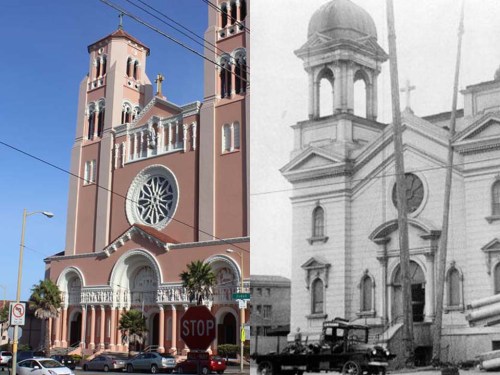
Christ Lutheran Church, 5th & Irving, August 1964


(via SF History Center)

And in 2015:

This sanctuary was built for Christ Lutheran Church, but it’s now home to St. John of God, a Catholic community. After outgrowing the space, Christ Lutheran’s congregation moved west to Quintara & 20th. In recent years, neighborhood groups have spearheaded efforts to underground utility lines to beautify the area.

6 Parnassus Line, 6th Avenue & Judah Street, 1947


(via SF History Centervia SF History Center)

And in 2015:

Many Muni bus routes are named after the streetcar lines they replaced. To extend the original 6 line to Pacheco & 9th Avenue, a neighborhood group called the Upper Sunset Improvement Club worked to raise $20,000. According to a January 1912 article in The San Francisco Call, “the need of a streetcar line into the upper Sunset district is imperative.”

Construction, 6th Avenue & Hugo Street, 1926

(via SF History Center)

And in 2015:

Today, the Kirkham Heights apartment towers and stately trees obscure the view of Mt. Parnassus from quiet Hugo Street.

St. Anne of the Sunset, Judah & Funston, August 1935

(via SF History Center)

And in 2015:

St. Anne was rebuilt after a partial collapse in 1935. The frieze above the front entrance was designed and sculpted by Sister Mary Justina, OP, who was born in Poland in 1879 as Anna Niemiesrski.

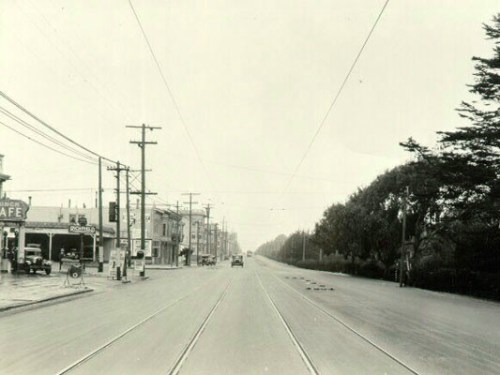
Cars parked illegally, Hugo Street at Arguello, December 1959


(via SF History Center)

And in 2015:

According to a 1959 article from the San Francisco Call, this photo depicts cars parked illegally on the sidewalk during a football game at Kezar Stadium, a few blocks away. According to the reporter, game day brought 40,00 vehicles into the neighborhood:

“Now, when you’re a football fan, that’s a convenient spot to live. Apart from the fact that you don’t need a car to take you to the game these days, junior can pick up a fast buck by squeezing a desperate spectator’s machine in your garage at a program parking rate…”
Leave a comment

Filed under History, Inner Sunset, San Francisco

Crimes Of Yesteryear: Butcher Butchered In Grisly 1913 Inner Sunset Slaying

Hoodline, 3/14/15

lincoln9th

Lincoln and 9th Ave. in 1929 (via San Francisco History Center, SFPL)

Even a century ago, the Inner Sunset was regarded as a generally quiet neighborhood where crimes were more likely to committed against property than people. As seen in the 1929 photo of Lincoln Way and 9th Avenue above, the area saw relatively little through traffic, and was a sleepy hamlet compared to the city’s hustle and bustle to the east.

But in 1913, one of the area’s goriest homicides occurred when a butcher was savagely murdered in his shop at 1254 9th Ave.

San Francisco Call, 5/17/13

On the evening of May 14th, the wife of butcher Egbert Annand brought her baby along to visit Clancy & Mueller, the grocery next to her husband’s shop on 9th between H and I Streets (later Lincoln Way and Irving Street). According to the San Francisco Call, Annand had come home for lunch and left “in his usual good spirits,” so when he failed to return for dinner, Mrs. Annand visited Mr. and Mrs. Clancy, “who sought to allay the distracted wife’s fears.”

At 8pm, Eugene Mueller, co-owner of the grocery store, entered the butcher shop after finding the door ajar. At the rear of the store, Mueller and friends came across Annand, whose “head was almost severed from his body,” reported the Call. About $275 in cash was missing, and a bloody knife was discovered under newspapers and bloody rags. Investigators determined that the door that separated the back room from the front of the shop had been “taken from its hinges and washed.”

1913 telephone directory

Suspicion fell immediately on Walter Scott, Annand’s 22-year-old delivery boy.

According to Louis Walters, a 15-year-old who also made butcher deliveries, Annand hadn’t been seen since lunchtime. At 5:30pm, Scott and Walters “took Annand’s machine” to Lincoln and 3rd for a delivery. At that point, Scott left Walters alone; when he returned, he “gave the youngster a dime and disappeared.”

When Scott was arrested and police discovered his bloody clothes in a garbage can, he gave officials “many conflicting stories.” Scott said he witnessed Annand’s suicide but chose not to report it for fear that he would be accused. During his July trial, Scott “was unable to explain … a number of inconsistencies.”

San Francisco Call, 7/17/13

The defense argued that Annand committed suicide because he was despondent over his failing new business. Unfortunately for Scott, the butcher shop had been “prosperous” since it opened, the victim suffered stab wounds to the back and “the palms of his hands were slashed to the bone,” suggesting defensive wounds.

On July 23rd, it took the jury a little more than an hour to return a guilty verdict of murder in the first degree. Scott was sentenced to a life term in San Quentin on July 25th.

The butcher shop appears to have closed, as it doesn’t appear in any phone directories in 1914.

Today, Annand’s butcher shop would occupy a space between a 3-story apartment building at number 1250 and Alaya Boutique at 1256 9th Ave.

Leave a comment

Filed under History, Inner Sunset, San Francisco

Meet New Yorker Cover Artist And Cole Valley Local Mark Ulriksen

Hoodline, 3/11/15

markulriksen

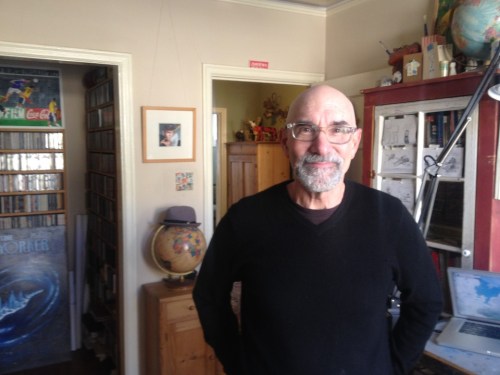
Mark Ulriksen is a Cole Valley-based artist whose work has appeared on the cover of The New Yorker 48 times since 1994. Beyond magazines, Ulriksen has created a large body of work for clients such as major ad agencies, publishers, universities, and well as global brands like Nike and United Airlines. His work has been collected by The Smithsonian, Martin Scorcese and Jimmy Buffet, and in 2006, the Magazine Publishers of America awarded him top news magazine cover.

Hoodline recently sat down with Ulriksen to learn more about his career, recent projects and how art and illustration are adapting for digital media.

Is there one magazine cover that you’re most proud of?

“That’s a tough question. I’m still a big fan of a New Yorker cover about society’s obsession with staring at phones, so I’d say this “Capturing the Memories” cover is one of my favorites. But I really don’t have one single choice. Tomorrow I may say something different.”

Courtesy Mark Ulriksen

You’ve worked with magazines for much of your career. Do you perceive more opportunities or fewer for artists since publishers have gone digital?

“Definitely the environment for editorial illustration has changed for the worse for illustrators. There are fewer ad dollars going to periodicals, which means fewer pages and fewer opportunities. Plus photography has always been more prevalent than illustration. The marketplace also seems to favor computer generated images these days as opposed to paintings such as what I do. Like any ephemeral field tastes and fashions come and go, but the digital shakeup is here to stay.”

Similarly, what are your thoughts about 7×7 magazine’s decision to go digital-only?

“Frankly. I wasn’t aware of that development … Good news for trees.”

What do you think of Uber’s recent decision to publish a quarterly magazine for its drivers?

“I’m guessing Uber could use some good press for a change so they’ll create their own. The old dividing line between editorial content driven by publishers versus that created by corporations is constantly being blurred. A magazine for Uber’s drivers sounds more like a company brochure than something aimed at consumers.”

Private commissions seem to comprise a lot of the work you do. How do people find you when it comes to something like a mural or a portrait?

“Private commission requests come from all sorts of places, from folks I know personally to people who are already familiar with my work or have stumbled across it. I’d have to thank Google for a lot of it. Plus in this day and age any artist has to constantly have an online presence so a lot of my time is spent marketing myself, which I really dislike doing.”

What was your first reaction when you learned that you were being awarded top magazine news cover by the Magazine Publishers of America?

“Probably some combination of shock and awe. I didn’t even know of the competition so it was quite a pleasant surprise.”

Of the awards and accolades you’ve received, which one means the most to you?

“Being a regular contributor to The New Yorker means the most to me. There aren’t many places where your work isn’t art directed, is seen by over a million people and is unmarred by cover lines and other text.

Have you created any public art in Cole Valley or San Francisco?

“Nothing for my neighborhood but I was one of three artists annually selected by the SF Arts Commissions Art on Market Street Program, where I had six posters up along Market Street for three months back in late 2013. My series was titled ‘Active San Francisco.'”

How did your last book, Dogs Rule Nonchalantly, come about? 

“I had collected about a hundred-and-some dog pictures I painted over the last 20 years. I laid them all out and thought, ‘How can I tell a story around them?’ I’d done an article for The Atlantic Monthly about 15 years ago about how dogs were so smart, they controlled humans. They get what they want, but they do it in a really nonchalant way.”

Day to day, what are you working on now?

“I’ve got to send out a Kickstarter portrait, just finished it up last night and have to send that off, I have to pick up a print from the printer for a client who bought a bunch of prints, I’m about to send off this painting here (gestures at an oversized New Yorker magazine cover).

“This was a request by Neil deGrasse Tyson, the astrophysicist. He wanted to have this seven feet high, but my original painting for the New Yorker was 12 by 16 [inches], so I said, ‘You can’t blow up that painting to seven feet, it’ll look terrible. I need to do a new painting for you, bigger. I’ve already done a 7-foot-high canvas print from this painting.”

Mark Ulriksen’s latest book, Dogs Rule Nonchalantly, is available online and in stores. For more information, visit Mark’s Facebook page or follow him on Twitter.

Leave a comment

Filed under Inner Sunset, San Francisco, Uncategorized