Monthly Archives: January 2016

Crimes Of Yesteryear: Sutro Forest Kidnapping, Masked Highwaymen, More Cowbell

Hoodline, 4/16/15

aae-1108

via San Francisco History Center

Our last look back at crime in the Inner Sunset focused on the grisly axe murder of butcher Egbert Annand, who died in his 9th Avenue shop at the hands of his delivery boy. Today, a roundup of stories from the meaner (and in many cases, unpaved) streets of the Inner Sunset from the early 20th century.

On July 23rd, 1905, The San Francisco Call reported that sisters Anne and Rose Flex appeared in Police Court. Anne was charged with “disturbing the peace of the Sunset district by ringing cow bells at late and unusual hours.” According to the report, this wasn’t the first trip to court for the Flex family, which “has been in the Police Courts before, charged with murdering sleep in the Sunset district.”

Rose Flex appeared to serve as her sister’s attorney, a legal strategy that was not well received by presiding Judge Fritz. After sister Rose “gave a sample of how she could argue,” he shouted for his bailiff to shut her down, stopping “what promised to be for the record a long distance oration in the Police Court.”

A different Police Court judge issued a warrant for the arrest of jeweler Joseph Gillis on January 5th, 1908. According to May McMurry of 1240 4th Ave., Gillis pawned a gold watch and a gold stick pin she had left with him for repairs.

Gillis was charged with felony embezzlement; adjusted for inflation, the $107.50 in goods he allegedly stole would be worth about $2,850 in 2015.

The San Francisco Call, 8/12/12

On August 12th, 1912, The Call reported that 12-year-old Jerome Crevas of 1708 Irving St. managed to escape from an “isolated shack” in Sutro Forest where two men and a woman held him hostage for several hours.

Crevas, the son of “one of the wealthiest Mexican merchants in Guaymas,” was playing in front of St. Anne’s Church at 14th & Irving on a Saturday afternoon when, “in full view of many people, a large, gray automobile pulled up to the curb.” A “well-dressed, middle-aged man” tossed Jerome in the rear of the vehicle before spiriting him past the almshouse (now Laguna Honda hospital) and “through the gate into Sutro forest.”

The kidnappers brought Jerome “to a lonely little shack hidden in a hollow” and locked him inside a small room. Once he realized that his captors left him alone, the boy crept through a window. “After an hour’s laborious walking,” Jerome emerged east of the present-day UCSF Parnassus campus, “ran down to the park police station and reported the kidnaping.”

Police visited the crime scene and verified Jerome’s story, but we weren’t able to find any follow-up reporting about the kidnap investigation.

The Call, 12/4/13

On December 4th, 1913, the Sunset Improvement Club voted to create a committee to urge SFPD Chief White to step up police protection in what was then a rapidly-developing neighborhood that lobbied actively for better public services.

The organization, an influential group of affluent homeowners and merchants, was spurred to action by “six holdups two in broad daylight, last Friday evening, all within a radius of several blocks.” One of the robbery victims was Rev W.L. Stidger of Calvary Methodist Church. At the time of publication, SFPD detectives were still gathering “indefinite clews to the three masked highwayman who have committed six saloon holdups and two shootings” in the prior week.

via SF History Center

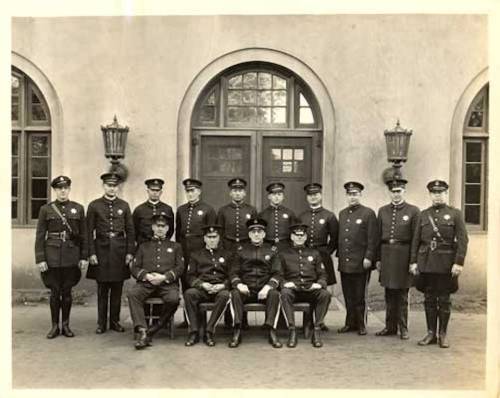
Finally, a happy ending: the June 9th, 1950 edition of the The San Francisco News-Call Bulletin reported the good news that 2-year-old Linda Durand of 1737 Clayton St. was reunited with her mother at Park Station after police discovered her “wandering around at Haight and Clayton sts.” In the photo, Linda “tries on a policeman’s star, under Patrolman Brian McDonnell’s approving gaze.”
Leave a comment

Filed under History, Inner Sunset, San Francisco

Now And Then: Picturing The Inner Sunset Of Yesteryear

Hoodline, 4/6/15

sunsetchurch2015

photo courtesy SFPL

Today, we turn back the clock to explore the Inner Sunset of years past through photos from the San Francisco Public Library that were plotted on a map by Old SF, a volunteer project created to expose the city’s history to a wider audience. (All of the vintage photos used in this article come courtesy of the San Francisco Library’s San Francisco History Center archive.)

Here’s a glimpse at some of the Inner Sunset scenes of yesterday, plus what each location looks like today:

Firehouse, 1348 10th Ave., as seen in 1915

(via SF History Center)

And in 2015:

Built in 1898, the first firehouse in the Inner Sunset is now the home of Ignatius Press, a Catholic publishing company. It stopped operating as a firehouse in 1962 before becoming a school in 1969; Ignatius Press purchased the building in 2008.

Christ Lutheran Church, 5th & Irving, August 1964


(via SF History Center)

And in 2015:

This sanctuary was built for Christ Lutheran Church, but it’s now home to St. John of God, a Catholic community. After outgrowing the space, Christ Lutheran’s congregation moved west to Quintara & 20th. In recent years, neighborhood groups have spearheaded efforts to underground utility lines to beautify the area.

6 Parnassus Line, 6th Avenue & Judah Street, 1947


(via SF History Centervia SF History Center)

And in 2015:

Many Muni bus routes are named after the streetcar lines they replaced. To extend the original 6 line to Pacheco & 9th Avenue, a neighborhood group called the Upper Sunset Improvement Club worked to raise $20,000. According to a January 1912 article in The San Francisco Call, “the need of a streetcar line into the upper Sunset district is imperative.”

Construction, 6th Avenue & Hugo Street, 1926

(via SF History Center)

And in 2015:

Today, the Kirkham Heights apartment towers and stately trees obscure the view of Mt. Parnassus from quiet Hugo Street.

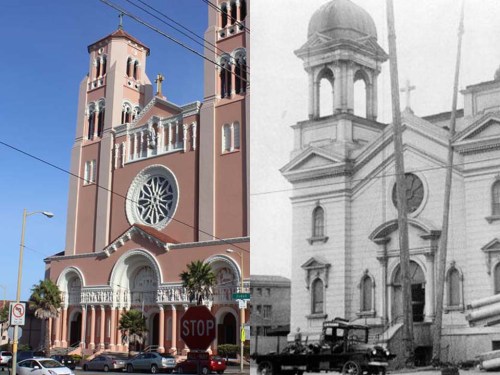
St. Anne of the Sunset, Judah & Funston, August 1935

(via SF History Center)

And in 2015:

St. Anne was rebuilt after a partial collapse in 1935. The frieze above the front entrance was designed and sculpted by Sister Mary Justina, OP, who was born in Poland in 1879 as Anna Niemiesrski.

Cars parked illegally, Hugo Street at Arguello, December 1959


(via SF History Center)

And in 2015:

According to a 1959 article from the San Francisco Call, this photo depicts cars parked illegally on the sidewalk during a football game at Kezar Stadium, a few blocks away. According to the reporter, game day brought 40,00 vehicles into the neighborhood:

“Now, when you’re a football fan, that’s a convenient spot to live. Apart from the fact that you don’t need a car to take you to the game these days, junior can pick up a fast buck by squeezing a desperate spectator’s machine in your garage at a program parking rate…”

Leave a comment

Filed under History, Inner Sunset, San Francisco

Crimes Of Yesteryear: Butcher Butchered In Grisly 1913 Inner Sunset Slaying

Hoodline, 3/14/15

lincoln9th

Lincoln and 9th Ave. in 1929 (via San Francisco History Center, SFPL)

Even a century ago, the Inner Sunset was regarded as a generally quiet neighborhood where crimes were more likely to committed against property than people. As seen in the 1929 photo of Lincoln Way and 9th Avenue above, the area saw relatively little through traffic, and was a sleepy hamlet compared to the city’s hustle and bustle to the east.

But in 1913, one of the area’s goriest homicides occurred when a butcher was savagely murdered in his shop at 1254 9th Ave.

San Francisco Call, 5/17/13

On the evening of May 14th, the wife of butcher Egbert Annand brought her baby along to visit Clancy & Mueller, the grocery next to her husband’s shop on 9th between H and I Streets (later Lincoln Way and Irving Street). According to the San Francisco Call, Annand had come home for lunch and left “in his usual good spirits,” so when he failed to return for dinner, Mrs. Annand visited Mr. and Mrs. Clancy, “who sought to allay the distracted wife’s fears.”

At 8pm, Eugene Mueller, co-owner of the grocery store, entered the butcher shop after finding the door ajar. At the rear of the store, Mueller and friends came across Annand, whose “head was almost severed from his body,” reported the Call. About $275 in cash was missing, and a bloody knife was discovered under newspapers and bloody rags. Investigators determined that the door that separated the back room from the front of the shop had been “taken from its hinges and washed.”

1913 telephone directory

Suspicion fell immediately on Walter Scott, Annand’s 22-year-old delivery boy.

According to Louis Walters, a 15-year-old who also made butcher deliveries, Annand hadn’t been seen since lunchtime. At 5:30pm, Scott and Walters “took Annand’s machine” to Lincoln and 3rd for a delivery. At that point, Scott left Walters alone; when he returned, he “gave the youngster a dime and disappeared.”

When Scott was arrested and police discovered his bloody clothes in a garbage can, he gave officials “many conflicting stories.” Scott said he witnessed Annand’s suicide but chose not to report it for fear that he would be accused. During his July trial, Scott “was unable to explain … a number of inconsistencies.”

San Francisco Call, 7/17/13

The defense argued that Annand committed suicide because he was despondent over his failing new business. Unfortunately for Scott, the butcher shop had been “prosperous” since it opened, the victim suffered stab wounds to the back and “the palms of his hands were slashed to the bone,” suggesting defensive wounds.

On July 23rd, it took the jury a little more than an hour to return a guilty verdict of murder in the first degree. Scott was sentenced to a life term in San Quentin on July 25th.

The butcher shop appears to have closed, as it doesn’t appear in any phone directories in 1914.

Today, Annand’s butcher shop would occupy a space between a 3-story apartment building at number 1250 and Alaya Boutique at 1256 9th Ave.

Leave a comment

Filed under History, Inner Sunset, San Francisco