Monthly Archives: January 2016

Meet New Yorker Cover Artist And Cole Valley Local Mark Ulriksen

Hoodline, 3/11/15

markulriksen

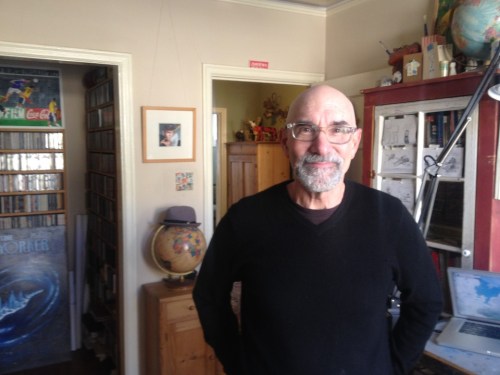
Mark Ulriksen is a Cole Valley-based artist whose work has appeared on the cover of The New Yorker 48 times since 1994. Beyond magazines, Ulriksen has created a large body of work for clients such as major ad agencies, publishers, universities, and well as global brands like Nike and United Airlines. His work has been collected by The Smithsonian, Martin Scorcese and Jimmy Buffet, and in 2006, the Magazine Publishers of America awarded him top news magazine cover.

Hoodline recently sat down with Ulriksen to learn more about his career, recent projects and how art and illustration are adapting for digital media.

Is there one magazine cover that you’re most proud of?

“That’s a tough question. I’m still a big fan of a New Yorker cover about society’s obsession with staring at phones, so I’d say this “Capturing the Memories” cover is one of my favorites. But I really don’t have one single choice. Tomorrow I may say something different.”

Courtesy Mark Ulriksen

You’ve worked with magazines for much of your career. Do you perceive more opportunities or fewer for artists since publishers have gone digital?

“Definitely the environment for editorial illustration has changed for the worse for illustrators. There are fewer ad dollars going to periodicals, which means fewer pages and fewer opportunities. Plus photography has always been more prevalent than illustration. The marketplace also seems to favor computer generated images these days as opposed to paintings such as what I do. Like any ephemeral field tastes and fashions come and go, but the digital shakeup is here to stay.”

Similarly, what are your thoughts about 7×7 magazine’s decision to go digital-only?

“Frankly. I wasn’t aware of that development … Good news for trees.”

What do you think of Uber’s recent decision to publish a quarterly magazine for its drivers?

“I’m guessing Uber could use some good press for a change so they’ll create their own. The old dividing line between editorial content driven by publishers versus that created by corporations is constantly being blurred. A magazine for Uber’s drivers sounds more like a company brochure than something aimed at consumers.”

Private commissions seem to comprise a lot of the work you do. How do people find you when it comes to something like a mural or a portrait?

“Private commission requests come from all sorts of places, from folks I know personally to people who are already familiar with my work or have stumbled across it. I’d have to thank Google for a lot of it. Plus in this day and age any artist has to constantly have an online presence so a lot of my time is spent marketing myself, which I really dislike doing.”

What was your first reaction when you learned that you were being awarded top magazine news cover by the Magazine Publishers of America?

“Probably some combination of shock and awe. I didn’t even know of the competition so it was quite a pleasant surprise.”

Of the awards and accolades you’ve received, which one means the most to you?

“Being a regular contributor to The New Yorker means the most to me. There aren’t many places where your work isn’t art directed, is seen by over a million people and is unmarred by cover lines and other text.

Have you created any public art in Cole Valley or San Francisco?

“Nothing for my neighborhood but I was one of three artists annually selected by the SF Arts Commissions Art on Market Street Program, where I had six posters up along Market Street for three months back in late 2013. My series was titled ‘Active San Francisco.'”

How did your last book, Dogs Rule Nonchalantly, come about? 

“I had collected about a hundred-and-some dog pictures I painted over the last 20 years. I laid them all out and thought, ‘How can I tell a story around them?’ I’d done an article for The Atlantic Monthly about 15 years ago about how dogs were so smart, they controlled humans. They get what they want, but they do it in a really nonchalant way.”

Day to day, what are you working on now?

“I’ve got to send out a Kickstarter portrait, just finished it up last night and have to send that off, I have to pick up a print from the printer for a client who bought a bunch of prints, I’m about to send off this painting here (gestures at an oversized New Yorker magazine cover).

“This was a request by Neil deGrasse Tyson, the astrophysicist. He wanted to have this seven feet high, but my original painting for the New Yorker was 12 by 16 [inches], so I said, ‘You can’t blow up that painting to seven feet, it’ll look terrible. I need to do a new painting for you, bigger. I’ve already done a 7-foot-high canvas print from this painting.”

Mark Ulriksen’s latest book, Dogs Rule Nonchalantly, is available online and in stores. For more information, visit Mark’s Facebook page or follow him on Twitter.
Leave a comment

Filed under Inner Sunset, San Francisco, Uncategorized

San Francisco’s Earthquake Shacks: Real Estate Deal Of The Century

Hoodline, 3/9/15

refugee5

Approximately 75,000 people left San Francisco after the April 1906 earthquake and fire, but about 20,000 hardy souls who stayed moved into makeshift housing created across 26 refugee camps—city parks that were transformed into tent cities. As the city rebuilt, these temporary structures were sold to private owners; a well-preserved specimen remains in the Inner Sunset on 10th Ave.

San Francisco Call, 5/24/1906

Rebuilding began as soon as the last fires were extinguished, but early housing demand far exceeded the supply. Although refugee camps started to close by the summer of 1906, thousands were left in canvas tents with winter approaching. To avoid another housing crisis, relief officials designed a more durable shelter that could be made from local materials.

Funded by the San Francisco Relief Corporation and managed by the Parks Commission, earthquake shacks came in three sizes and cost anywhere from $100 to $742 in labor and materials. According to the Western Neighborhoods Project, union carpenters built about 5,600 cottages in three sizes. Decked out in olive drab paint (more Army surplus), earthquake shacks were rented out for $2 to $6 per month.

San Francisco Call, 1/6/1907

At peak occupancy, 16,448 San Franciscans lived in earthquake shacks, which could be purchased for $50. The May 24, 1906 edition of the San Francisco Call declared that “Refugees May Remain as Long as They Are Without Homes,” but a January 6, 1907 headline, “Single Men Must Leave Parks,” suggests that officials were eager to resettle refugees in neighborhoods.

Even for the era, $50 was a sweet deal for a free-standing home, even if it had to moved at the owner’s expense. The structures were built from fir, redwood and cedar and were so durable, they could be hoisted by their roofs and transported by cart.

courtesy Bancroft Library

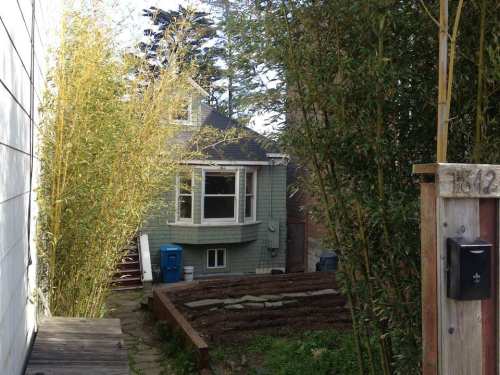
The earthquake shack at 1842 10th Ave. is one of approximately 100 that remain in the city. Since it was relocated from one of the city’s refugee camps in 1908, it’s been remodeled to include two bathrooms and expanded to 920 square feet with two bedrooms. The front yard has a garden area and is enclosed by bamboo and a privacy fence.

Boasting a living room fireplace and a large unfinished attic, Zillow reports that the property last sold for $509,000 in March 2009. Today’s estimated value is $960,000, giving this dwelling a nearly 20,000-fold increase in value.

Leave a comment

Filed under History, Inner Sunset, San Francisco

What It Takes To Buy A House In The Inner Sunset

Hoodline, 3/6/15

innersunset1

Flickr/Shawn Calhoun

The Inner Sunset has grown in prominence as a hot San Francisco real estate market, and we caught up with Ilana Minkoffa Realtor with Vanguard Properties, to learn more. Although she helps clients buy and sell across the city, Minkoff shared insights into the unique challenges of purchasing real estate right here in the Inner Sunset.

What’s the most notable change to the Inner Sunset’s real estate market that you’ve observed in recent years?

“What used to be a fairly under-the-radar neighborhood has become a recently discovered gem. It has a laid back, unpretentious family feel. And being so transit and bike friendly, it’s become a great alternative to more pricey neighborhoods. As with the rest of San Francisco, inventory in the Inner Sunset is very low, so with such high demand, prices are on the rise.”

Photo: Walter Thompson/Hoodline

How many homes have been listed for sale in the Inner Sunset in the last 12 months?

“In the last 12 months, 67 properties, including single-family homes, condominiums and tenancies-in-common, have sold according to the MLS. As of March 3rd there were only three active listings on the MLS. That being said, about one-third of the properties are sold ‘off-market’ which means they are never put on the MLS. This is happening citywide. Working with a good Realtor is key to finding ‘off-market’ properties.”

Flickr/Mark Hogan

In your experience, what’s the biggest surprise for first-time homebuyers in San Francisco?

“I’m constantly reminding my buyers to stay positive. Competition can be fierce. I always tell my buyers it’s normal to write 3-4 offers before one is accepted. Then if they get one accepted faster, they’re thrilled. Buyers often don’t believe that a property will sell so far over the list price until they see it with their own two eyes. So my job is to set expectations and get them prepared for the journey so they avoid getting discouraged.

“As a seasoned Realtor who’s worked with plenty of first-time buyers, I educate them on the buying process before they start shopping. They should follow the market, go to open houses and track properties for a few months before jumping in to make offers. That way it’s not shocking when we have to go 20 percent or more over the list price on an offer. I remind them interest rates are still really low, so now really is a great time to buy. Home buying in this market really is more of a marathon than a sprint.”

Is there a specific type of person or demographic that’s moving to the Inner Sunset? What do they do for a living?

“One of the really special things about the Inner Sunset is the diversity of the population. A wide variety of people are moving here. Many are young families who want an easier lifestyle, parking, a yard and to be able to take the kids to the park are drawn here. Of course there is a considerable amount of money coming in from the tech sector citywide, and that is also the case here. Proximity to UCSF is also a draw for their staff. The largest age range in the 94122 area code is the 21-34 year olds with a median income of $81,000 (according to Claritas.com).”

Flickr/brutalworks

Anecdotally, what draws prospective buyers to the Inner Sunset?

“A lot of people are drawn to the Inner Sunset because they’re looking for a mellow, laid-back, transit-friendly, affordable area of town. They love the being close to Golden Gate Park and how easy it is to get to the beach. The housing prices are still quite a bit lower than other areas, making it more affordable than more eastern neighborhoods. And you can often get far more space for your dollar than other parts of town. The wide variety of great restaurants, the Sunday Farmer’s Market and shopping around 9th and Irving is definitely a draw as well. And because it’s relatively flat, you can leave your car at home, take a nice walk and enjoy everything the Inner Sunset has to offer.”

What advice, if any, do you have for renters who are seeking to become homeowners?

“Start planning early. Have a goal. It’s never too soon to meet with a financial planner or lender to make a plan. Whether you are starting at the very beginning with saving for your down payment or getting close to go time, get a plan.”

How large of a down payment will someone need (ballpark)?

“The general rule of thumb is 20 percent of the purchase price.”

Would you ever counsel someone against his or her first choice of property? If so, why?

“Of course. I frequently equate buying a home to dating, because it’s something everyone gets. Sometimes you go out on a first date and you are absolutely sure that person is the one you are going to spend the rest of your life with. You think they are perfect! But as we all know, you can be so blinded by lust you can’t see their faults. My job is to be that gentle friend that reminds you to really look at their qualities, good and bad before putting a ring on it.”

Do you have stories about house-hunting in the Inner Sunset? Let us know in the comments.

Leave a comment

Filed under Inner Sunset, San Francisco, Uncategorized