
Category Archives: Social Media

CTRL + C and CTRL + V = inappropriate crisis management

This post isn’t about Rush Limbaugh. It’s about how companies react to a crisis.

Several days ago, out of professional curiosity (and a wee bit of schadenfreude), I visited Twitter and Facebook accounts belonging to several of Limbaugh’s sponsors.

Most circled the wagons while they settled on a strategy. (Five will get you ten that no Community Managers participated in these conversations.) While the suits crafted a corporate response, their social media drones flew in tight formation, awaiting instructions.

Which brings me to ProFlowers’ Twitter page.

One of my guiding principles (at work and in life) is that at any given moment, we’re all doing the best we can. So when I saw this, I was surprised and a little sad (click to enlarge):

ProFlowers.com Twitter feed, March 2, 2012

ProFlowers.com social media team: if this is the best you can do, I respectfully suggest that you find a new line of work. Preferably one where you don’t interact with the public.

Consider how much white-hot outrage it takes the average American to write an angry letter, then ask yourself whether CTRL + C and CTRL + V is appropriate crisis management.

When people still sent letters of complaint, marketers could get away with cookie cutter, Mail Merge responses like these. Using social media as a rubber stamp isn’t just lazy, it’s disrespectful; you’re telling customers (and your competitors) that contacting you was a complete waste of their time. For some ProFlowers.com female clients, I imagine it added insult to injury.

ProFlowers might have alienated fewer people if they’d simply posted an opaque response to buy some time and went dark until they had a real announcement to make.

Put another way: a florist in a small town sponsors a local bowling team. After the team loses a tournament, several keglers start a brawl that results in injuries, arrests and very unflattering local news coverage. Because the team was sponsored by Roger’s Florists, a group of concerned citizens visits the proprietor to find out if he’ll continue supporting the team.

Each time a customer asks Roger whether he’ll keep buying bowling shirts and shoes for the team and letting them use his van for road trips, he extracts a 3 X 5 card and clears his throat before reciting:

“Your concerns affect how we manage our dealings with local sports teams. Thank you again for your feedback.”

or:

“I understand your concerns and I will ensure that your feedback is communicated to the manager of the bowling team.”

Even after Roger washes his hands of the bowling team, how many customers will keep him at the top of their list the next time they have a need for a florist? There’s a lot of competition out there.

1 Comment

Filed under Community Management, Internet, Social Media

The tribe.net experience, part 2

In part 1, I wrote about how community management contributed to tribe.net’s success and how traditional marketing played a key role in the company’s downfall, but those are small aspects of a larger story.

I put a call out to some former co-workers to get their input; the folks who responded were both early Engineering hires, and they each affirmed that my input into the product development process added value. If I get more feedback from other teammates, I’ll share it here. (And folks, if you don’t mind me sharing your names, let me know so I can edit this post.)

The reply I received from Engineer 1 suggested that I was was an effective proxy for our members, but that our overall progress toward creating a highy functional, user-friendly product was spoiled by “too many cooks.” As a result, he said that our service became less successful over time, even though we had direct and actionable feedback from end-users telling us exactly what they needed and wanted.

I agree with his assessment that what we were creating was “truly revolutionary.” We didn’t rely on the cold calculations of the social graph “to provide advertisers with a better view into what to try to sell me.” At times, our social network was “maddeningly hard to use, stupidly fragile and yet, it serves the needs admirably.” He also wrote;

“Who you report to is immaterial if leadership is dedicated to providing utility, usefulness or entertainment, or, as seems to be the vast majority case, not dedicated to such.”

In part 1, I suggested that Community Management might have been more effective if it’d been run out of Operations. My reasoning was facile; Ops generally gets the resources it needs, because when it doesn’t, things break down. This was a pretty simple reading of Operations teams, and I’ve got some second thoughts about that.

Engineer 2 praised me as “the ultimate user advocate … and therefore should have been a part of the Product organization with significant upstream input on features and priorities.”

In hindsight, I agree with him completely. The person writing/reviewing Product Requirement Documents has a permanent seat at the table, even if they attend more meetings than they care to. However, I never really felt that my CM input was embraced by the entire product team. I got along well with our PMs, but I’ll never forget the afternoon I turned to one in frustration and asked if we could prioritize the development of some admin tools that would reduce the amount of manual work I had to do.

I’ll never forget his response:

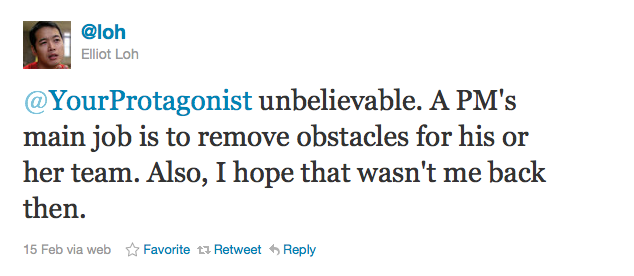
“It’s not my job to make your job easier.”

I was a little floored by such a baldly disinterested response. Instead of interpreting it as rudeness, I decided to assume that this was the way all product managers operated and that I must have crossed a line.

Several years later, a talented product manager (and several former co-workers) set me straight, and I’m deeply appreciative.

Another reason I’m certain tribe.net thrived early on is because everyone owned their role. I recently heard someone say that working in an immature startup is like little-league soccer; regardless of their respective positions, everyone swarms the ball if it rolls their way.

I’ve seen that problem writ large at many firms, but not at tribe.net. In terms of mutual respect and teamwork, I’ll be lucky if I ever find an culture/environment like that again.

Maybe I’ll have to create one.

2 Comments

Filed under Community Management, Internet, Personal, Social Media, Uncategorized

The tribe.net experience, Part 1

Here’s a snippet of a comment friend and former colleague Brian Lawler left on my last post about the marginal nature of community management:

Here is my question though, regarding the tribe.net experience. There, you had the level of trust that you needed to serve as Voice of the User, which is exactly what is needed, but it’s not clear from reading how that actually turned out. Was the team able to take full advantage of the arrangement or did something else go wrong? Who was the right person to actually report to?

Also, I would think there are some product managers out there who feel like it is THEIR role to be the Voice of the User. What do you think about that?

My initial response was to send an email to several past co-workers to ask them for their input, and I hope I can share their answers here. Memory is so subjective that this story would be better told Rashomon-like by several different actors, each with a unique perspective. I’ll cop to the fact that part of my desire for multiple POVs is born from a reluctance to speak publicly about a past employment situation, but this was several years ago, and we’ve all gone on to bigger and better things. It’s all good.

The reasons for tribe.net’s decline were manifold. What started as a more robust alternative to Craigslist quickly took on a life of its own when our members decided that they’d prefer tribe.net to be a social network. Our founders and staff were nimble enough to pivot and create a dynamic product that grew to accommodate the community, but after we matured, we brought in corporate decision-makers who had traditional ways of thinking about marketing and management. Let me draw you a picture:

For a time, tribe.net had the largest unlicensed outdoor billboard in San Francisco. The banner displayed our logo and took up the better part of one side of our building, a former warehouse on Potrero Hill, so it was clearly visible to northbound commuters. Here are two logo shirts; the first features our original branding created by Elliot Loh:

Tribe T-shirt, original logo by staff designer

tribe.net T-shirt, original, in-house logo

This logo — the one that appeared on that giant billboard — was created by an outside agency. I don’t know exactly how much they got for delivering their creative brief, but office scuttlebutt had it pegged north of $150K:

New tribe.net logo by agency

tribe.net logo designed by an agency for a giant pile of money

The one on the bottom is in excellent shape for a 6-year-old T-shirt. Because I never wear it.

The second logo had different treatments; on the billboard, the blobs and dots transformed into smiling faces of presumably happy tribe.net members. A PR person worked to make sure that we had a sufficiently diverse range of people represented, but because there was no demographic data to draw from, they did what Marketing folks do and made a representative multicultural constellation. I was asked — no, pressured — to be photographed for the mosaic, but I declined politely each time. In retrospect, it was 50% because I was opposed to the branding and 50% because saying “no” was the only power I had to exercise.

When they were wrapping up the photo shoot, someone realized that they came up short; they didn’t have enough African-American men for the poster. The Marketing VP explained the situation to me, and I could tell he sincerely wanted my help; for the first time in memory, he wasn’t addressing me with his feet up on his desk, arms folded behind his head.

“Come on, Walter. We need some color.”

I let him know I wasn’t available and went back to my desk. They ended up drafting the building’s genial security guard to round out the rainbow.

I share this story to illustrate how corporate thinking and management style calcified a dynamic organization.

Another example: I submitted repeated data-driven requests to prioritize the development of better administrative tools. We were adding new members at a brisk clip, but we were extremely light on the tools we needed to scale up support operations. Unfortunately, the work ethic I inherited from my father (30 years at IBM) wouldn’t permit me to let things slip too far.

As a result, I screwed myself; because the work was getting done (manually), there was no strong business case to prioritize the admin tools. (I just typed and then deleted a reference to a cotton gin. OK, Moving on.) With a different manager, I probably would have stayed with tribe.net longer.

Reporting to the VP Operations would have provided the greatest benefit to me and to our community. Operations is tasked with ensuring that regularly-occurring activities are carried out efficiently, so putting CM under that umbrella would have kept me relatively dry. If you manage server infrastructure and equipment purchases, a request for an interface that permits someone to search member accounts by date created gets consideration.

In Part 2, I’ll answer Brian’s question, “…I would think there are some product managers out there who feel like it is THEIR role to be the Voice of the User. What do you think about that?

Thanks for reading, comments are encouraged!

1 Comment

Filed under Community Management, Internet, Personal, Social Media